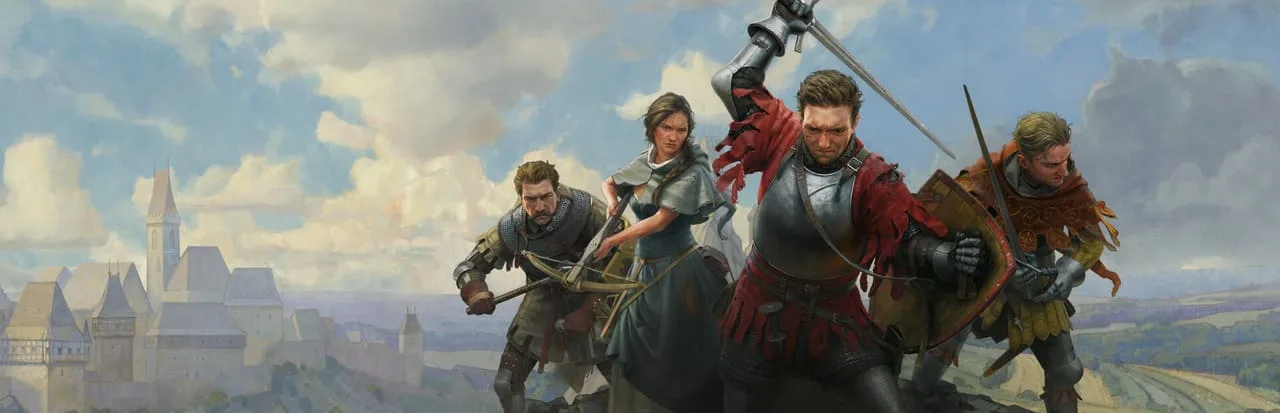
The short version
A historical open-world RPG with a level of simulation few games attempt: real economies, real illness and injury systems, dialogue that reads like it was written by people who actually researched 1403 Bohemia. Combat is deliberately unforgiving early on, and reviewers agree the first several hours ask a lot before the game starts paying it back.
What works
- One of the most systemically dense open worlds in any RPG
- Combat with real weight once you've learned it
- A script and cast that treat the setting as more than scenery
- A real, meaningful jump in scope and polish over the first game
What doesn't
- Early combat is brutally difficult before your gear catches up
- Lock-on can leave you exposed to enemies you're not facing
- Stealth is the least developed of the game's systems
- Some technical hitches were reported on consoles at launch
What it is
Kingdom Come: Deliverance II is a first-person, open-world RPG set in early 15th-century Bohemia, following blacksmith's son Henry through a kingdom fractured by civil war. It picks up directly from the first game's plot but is built to stand on its own, and its ambition is scale: real towns, real trade routes, and a simulation layer — hunger, sleep, disease, reputation — that most open-world RPGs don't attempt.
Warhorse Studios has always pitched this series as historical rather than fantastical, and the sequel leans further into that: no magic, no monsters, just period-accurate politics, combat and craft.
Combat: earned, not given
The much-discussed sword combat returns with a directional-strike system that rewards reading an opponent rather than button-mashing — and reviewers are broadly aligned that it is genuinely difficult in the opening hours, when Henry has poor gear and worse stamina.
The most common specific complaint is the lock-on: committing to one enemy in a group fight can leave you blind to a second attacker circling in from off-screen, which several reviews flagged as the sharpest remaining rough edge in an otherwise heavily revised system.
It's brutal early, and then one day you parry three strikes in a row without thinking about it, and the whole game clicks.
A kingdom built to be lived in, not toured
Where the combat asks patience of you, the world gives it back. NPCs keep schedules, prices shift with local supply, and quests routinely have more than one honest solution — critics have consistently pointed to this systemic density as the game's clearest strength, and the thing that separates it from more scripted open-world peers.
Stealth is the one system that reviewers generally agree hasn't kept pace with the rest: detection can feel inconsistent, and it's the part of the toolkit most likely to frustrate rather than reward.
A real step up from the original
The first Kingdom Come shipped rough and was patched for years afterward; the sequel is broadly reported as a much more stable, better-optimized game at launch, even with some console-side hitches reported in the opening weeks. Warhorse has continued to patch it, and a next-gen 4K/PSSR update later added further console polish.
Performance on PS5, PS5 Pro and Xbox Series
Per Digital Foundry's coverage, all three current consoles offer a genuine 60fps performance mode, with PS5 Pro adding PSSR upscaling for a sharper image at that frame rate.
| Mode | Resolution | Frame rate | Load |
|---|---|---|---|
| PS5 / Series X · Fidelity | 1440p (FSR to 4K) | 30fps | — |
| PS5 / Series X · Performance | 1080p (to 1440p) | 60fps | — |
| PS5 Pro · Performance | 1296p (PSSR to 4K) | 60fps | — |
| Xbox Series S | 1080p | 30fps | — |
Accessibility and comfort
- Remappable controls on all platforms
- Adjustable combat difficulty, separate from world difficulty
- Subtitles with adjustable size and background
- Objective markers and compass can be reduced for a harder, more map-reliant mode
- Motion blur and camera shake can be disabled
Is it worth it
$69.99 (Gold Edition $89.99 with the expansion pass) for what critics have widely called one of the best RPGs of the last decade — on Steam it has settled around 93% positive across well over 100,000 reviews. The early-game difficulty spike is real; players who push through it are the ones who tend to come back and call it a masterpiece.
If you liked this, play
How we reviewed it
This review is informed by Warhorse Studios' own patch and design notes, Digital Foundry's technical analysis, and the wide body of critical and player response gathered since the February 2025 launch — not first-party lab testing by this desk.